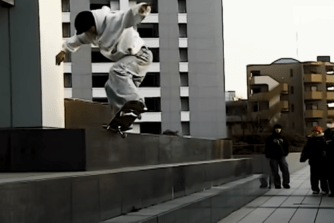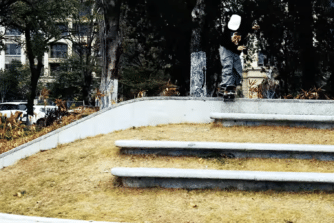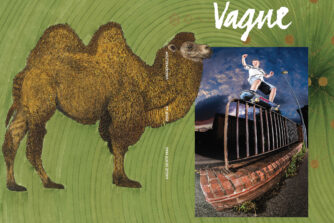

With the release of Ryuhei Kitazume’s absolutely incredible Tightbooth part Main Story, we decided to upload his interview as printed in Issue 48.
Issue 48 is still available in our shop, with a selection of other issues as well as a whole medley of merch.
Thanks so much to Lawrence Fung, Changsu, Iseki Nobou & Gerard Riera for the photos, Jono Coote for the write up and Lawrence Keefe for facilitating it all.
Words by: Jono Coote
Photography by: Lawrence Fung, Changsu, Iseki Nobou & Gerard Riera
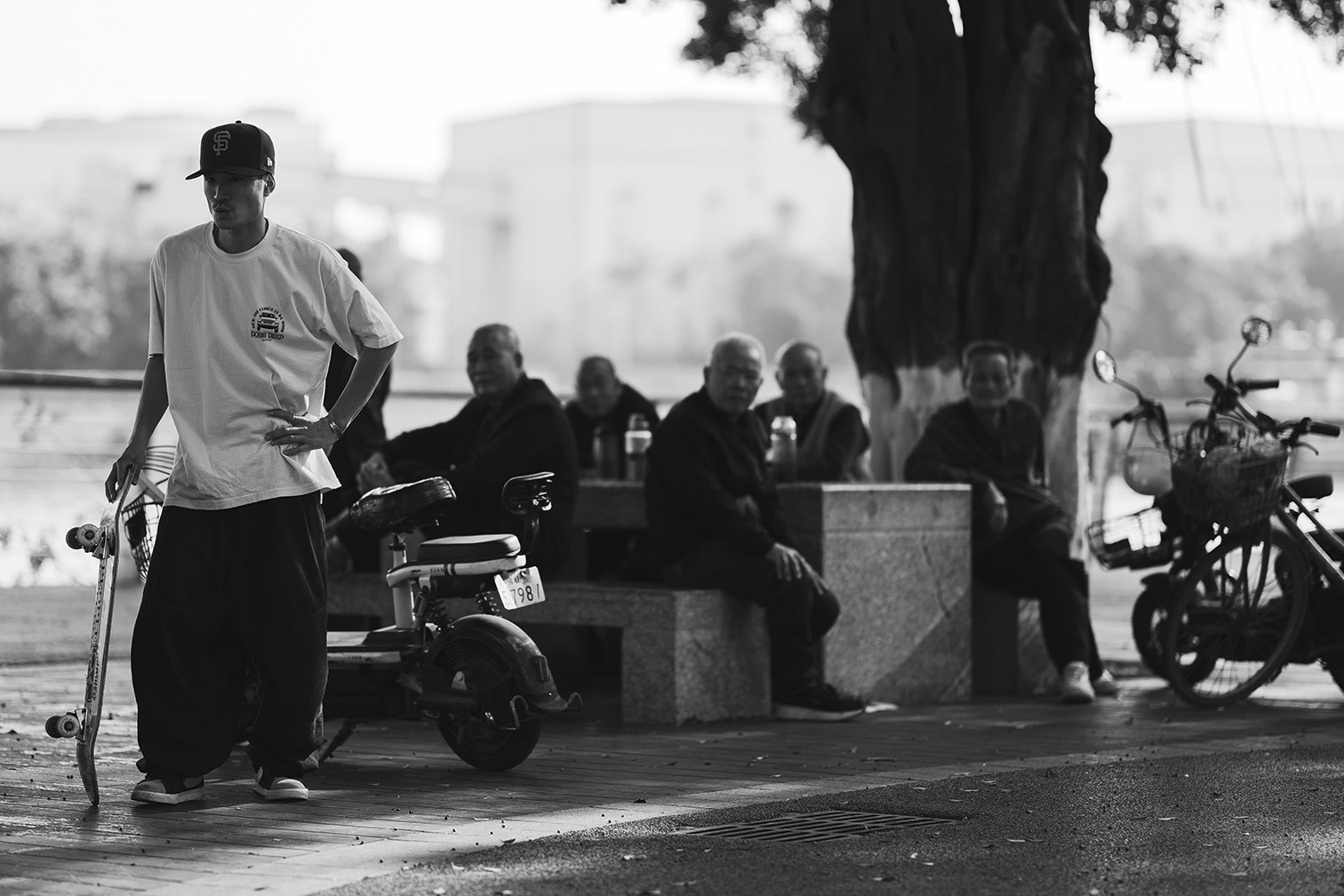
Portrait by: Lawrence Fung
A skateboarder’s style, incubated in very specific architectural, social and cultural conditions, will be indelibly shaped by the spaces which play host to their early years. The spots at which we learn to skate inexorably mark us, changing our patterns of thinking and moving, even shaping us physically in terms of scars and broken bones just as we shape them in terms of wax marks, chipped ledges and crumbling coping blocks; a dialogue of destructivity/creativity between man and man-made. Examples abound; from the transition chompers of America’s Pacific Northwest to the crust connoisseurs of The Wirral and from Barcelona’s ledgetarian bent to the peculiarly Australian trope of the Queensland ‘sand skater’ (coined as a diss, worn as a badge of honour). The skaters of Japan, whose formative experiences are built around semi-regular conflict with security guards, police and pedestrians, is by necessity one built around a mercurial fluidity. This is not the fluidity of, say, Matt Rodriguez, blasting in joyous freedom through the Sacto streets; it is something altogether twitchier, born of a need to be constantly prepared for the boot, to take something positive from what may be the most fleeting of sessions. Ryuhei Kitazume, as evidenced by an ever-growing body of footage, is evocative of this despite – this despite his having been raised in the unusually skate-friendly confines of Sega Mae Plaza in Shonan. Speaking to him via email, I am intrigued at how his experience varied from the usual cat-and-mouse games.
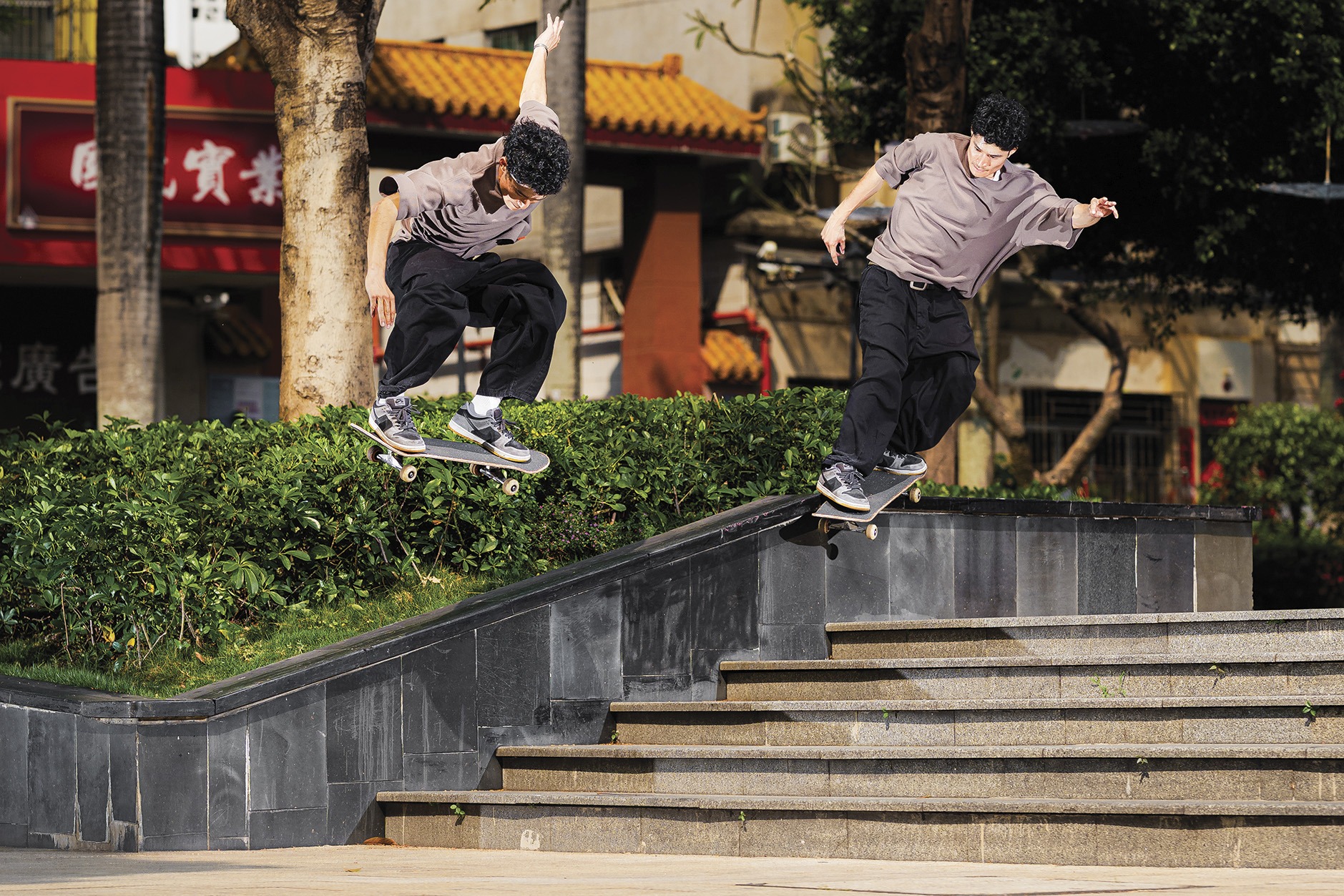
Ryuhei Kitazume – Backside Smith Grind Gap Out ~ Photo by: Lawrence Fung
“Yeah, I didn’t get busted much until 10 or 12 years ago. It’s pretty rare to find a skateable plaza here, since most Japanese cities aren’t built like European ones. In central Tokyo or other big cities especially, it’s almost impossible to skate for long without getting kicked out. I was super lucky to grow up there; not just because we could skate, but because it wasn’t a skatepark. We definitely skated a lot, but we also just loved hanging out there. In the summer we’d bring our boards, skate a bit, jump into the water and have BBQs. Those experiences really shaped my mindset.”
It allowed him a certain relaxed upbringing in terms of learning or filming tricks. “At Sega-Mae there was no need to rush at all. You didn’t even have to plan anything for filming; if you felt good and wanted to try your trick that day, you’d just ask Pong or Toeda to grab the camera. Everything happened naturally.”
With security-dodging such a central tenet of Japanese skating, I wonder how much his approach had to change once he started heading into the city; did he have a system for skating spots long enough to get a clip? Maybe going beforehand to see when it’s quiet, or slipping laxatives into the security guards’ drinks when they’re not looking?
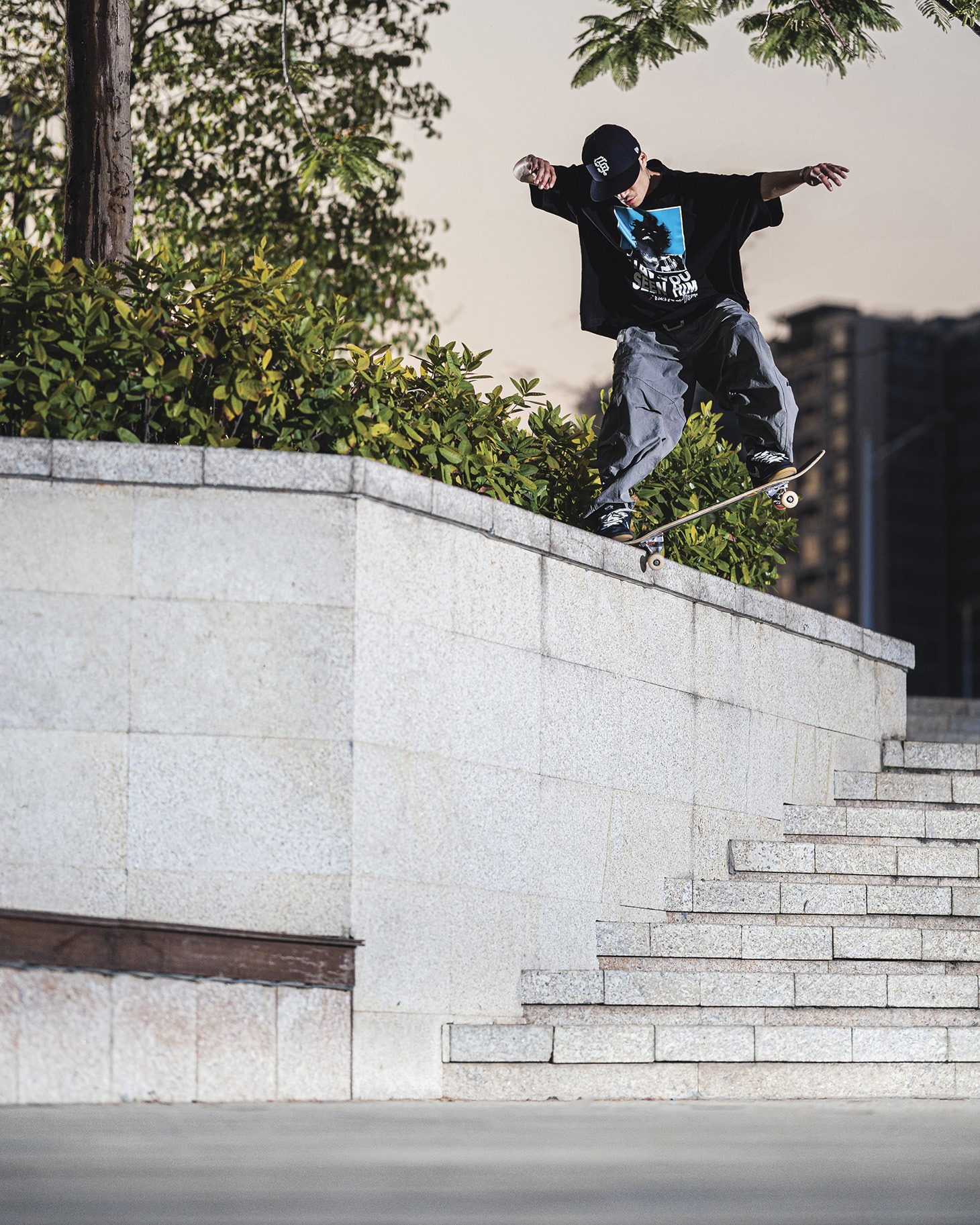
Ryuhei Kitazume – Half Cab Crooked Grind ~ Photo by: Lawrence Fung
“Once you start skating spots in the city, it’s a whole different story. You have to rush everything whilst dealing with security or the police. At first, I kind of enjoyed that part of it – the tension and the challenge – but, if it happens too much, it gets exhausting. I usually like to check out the spot beforehand, see what’s around, how close the houses are, where the security office is, stuff like that. I try my best to avoid problems. But honestly, it rarely goes as planned.”
A certain bloody-mindedness is required, a level of tenacity to skate at such a high level in gruelling conditions, accepting with equanimity when it might pay to return another day.
“There was one spot I really wanted to get a trick at. I went there like five different times – early in the morning, noon, midnight, even weekends – but nothing worked. In the end, I somehow landed the trick with the security guard in the background. It was around 5pm, which is definitely not a good time to skate in front of an office building. So yeah, you need to plan, but you also have to stay flexible.”
I’m always struck when watching Japanese skate videos by the variety of spots; marble stair sets, banked sculptures, crusty steep transitions. Is it the resistance to street skating in Japanese society that has caused this? Does not having a central plaza spot in most places mean that you have to be creative in hunting for spots that aren’t busts?
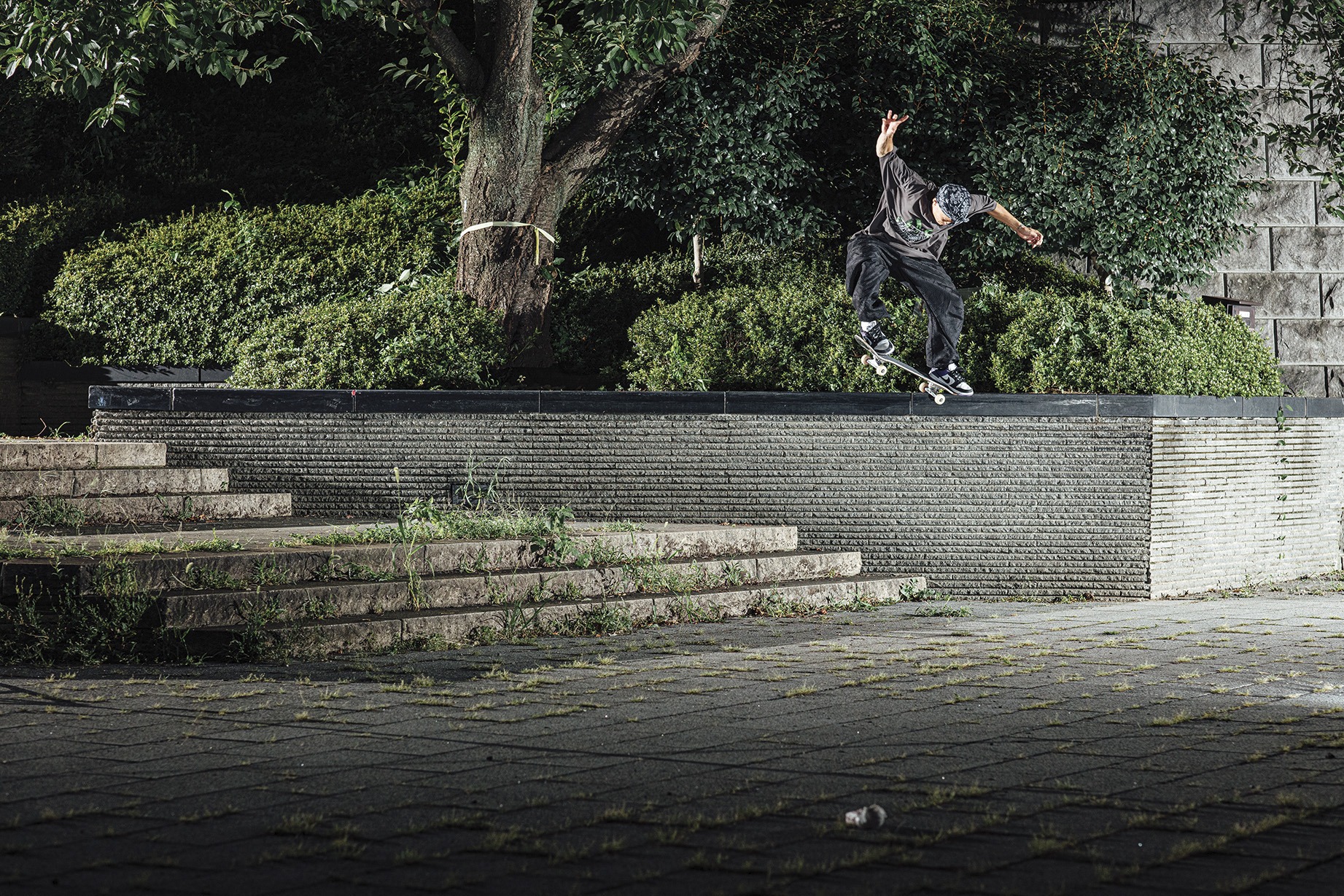
Ryuhei Kitazume – Nollie 180 Switch Crooked Grind ~ Photo by: Changsu
“Yeah, not having a central plaza might be one reason, but honestly, even those “Japan-looking” spots usually get busted. There are very few places where you can actually spend time skating in the streets, so you have to be creative when it comes to finding and using spots.”
At a recent skate event, I heard being discussed the fact that skateboarding’s inclusion in the Olympics actually resulted in a wider crackdown on street skating, as the sudden growth of skateparks was used as a reason to implement city centre bans. It is very much arguable in this case that skateparks are being used as a tool of hegemonic control, a tokenistic offer of support to the skate scene which in actuality is an attempt to stifle it, to keep it within a specific box. And, in turn, this can stifle a level of creativity essential to skateboarding as its proponents are cut off from learning to navigate the streets and interact with the myriad of other individuals and groups who call the city home.
“Street skating gives you raw, real-world experience, influencing your attitude, your style and how you find your place in the world. It has taught me to read my surroundings better and adapt. It’s not really about learning new tricks, but more about developing flow and awareness; how to move with the environment instead of fighting against it.”
An undoubtedly Zen sentiment, though one which comes with a caveat; “Though, sometimes, you’ve kinda have to fight it.”
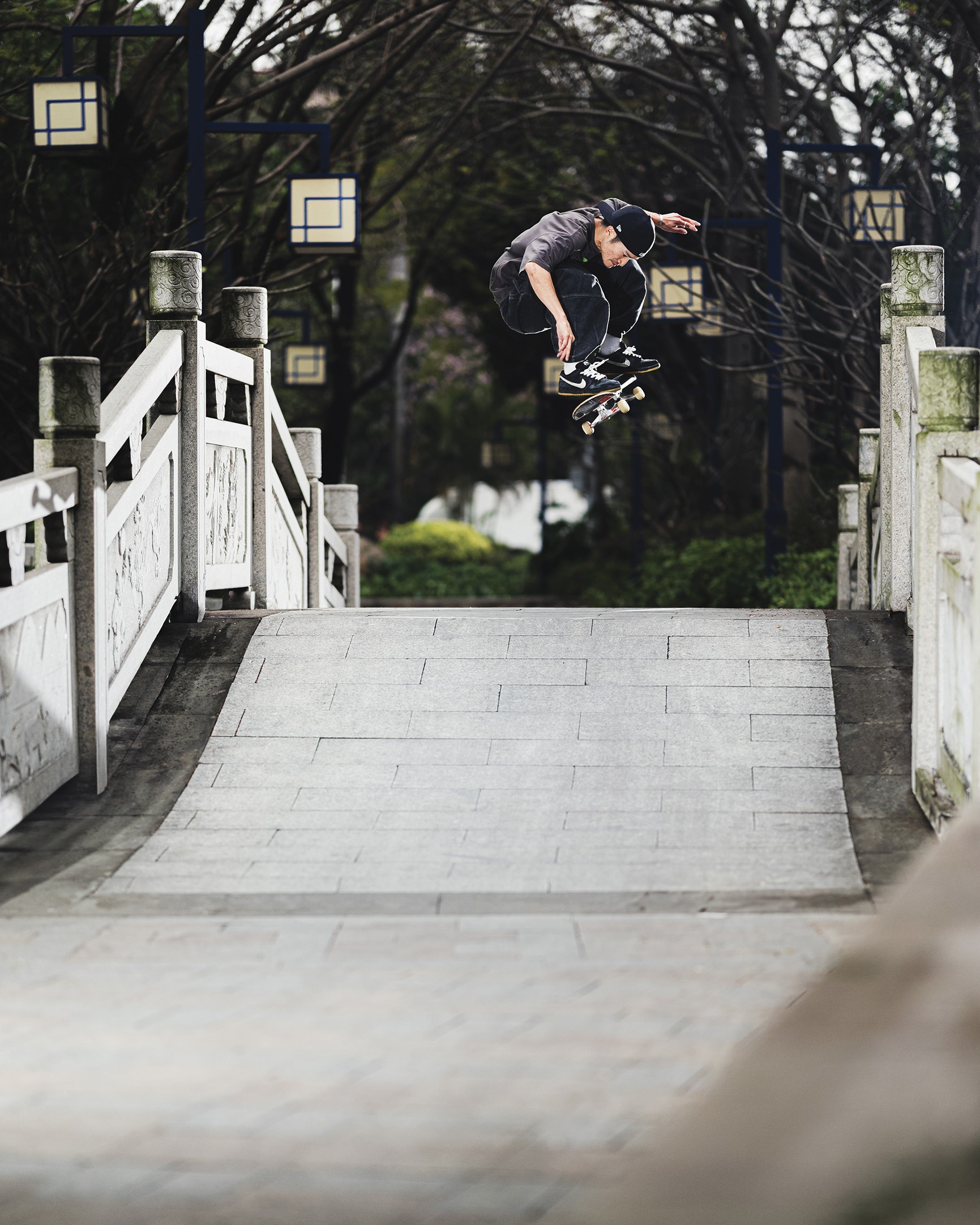
Ryuhei Kitazume – Nollie Heelflip ~ Photo by: Lawrence Fung
And, in such a hostile environment, skateparks do play their part. For young people starting out, it is helpful to have somewhere where they can figure their way around the useless wooden serotonin stick without constant interference and learn those building blocks which will help them navigate the urban sprawl – a negation of a negation, in terms of the dialectical materialism of tre flips. It is also important not to underestimate the ways in which these spaces that act not only as training facilities but as social hubs, a space where a day can be wiled away hanging out with friends, figuring out what your legs have in them and seeing what strange mutant strains of humanity may pass through their gates; drunks, proselytizers, poets, junkies, scientists, people with certifiable proof that the whole human race is descended from chinchillas; and it is this gaining of different perspectives that Ryuhei singles out when talk turns to the subject of skatepark appreciation;
“If you only skate the same spots in the street with the same crew, there’s less chance to meet different kinds of skaters. Meeting new people and seeing new styles can really open your mind. I always get little bits of inspiration from other skaters. The way they approach a spot, how they dress, or just how they carry themselves, those small things keep influencing how I see skating and how I express myself through it.”
Spending some time recently exploring Europe with industry stalwart Ant Claravall, he got to explore the best of both worlds.
“I felt that, in Europe, skateboarding was more accepted as a part of everyday street culture. People would pass by and sometimes even stop to watch or say something supportive. It felt a lot easier to skate in a big group without having to stress. That relaxed atmosphere made it easier to think creatively and come up with new ideas while skating.
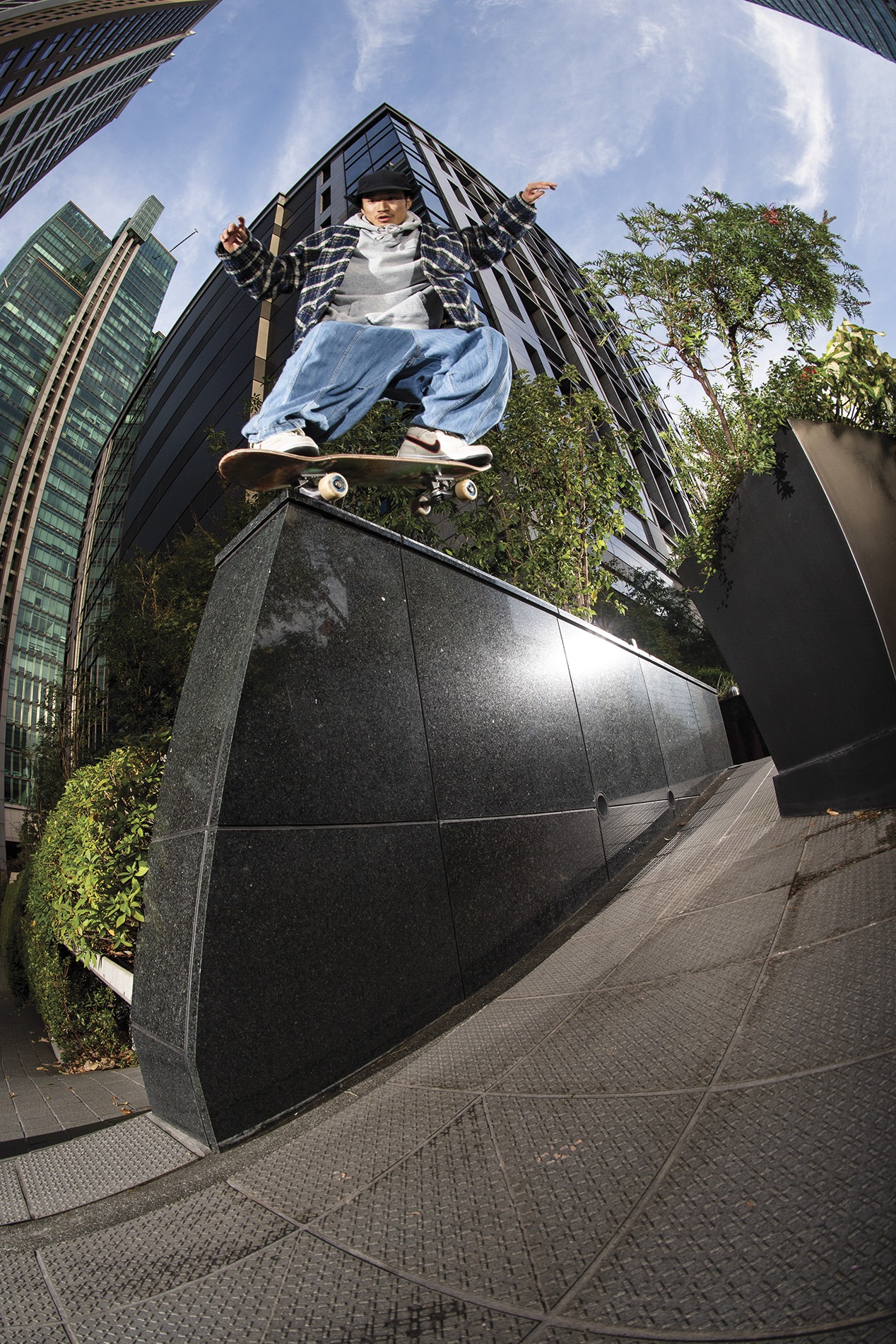
Ryuhei Kitazume – Backside Nosegrind ~ Photo by: Iseki Nobou
“You definitely feel more negativity from people in the streets here. Japanese people tend to follow the rules, which is sometimes good but sometimes not. Since street skating is technically illegal here, we’re often seen as the bad guys. Of course, some people in Japan like skating, but the percentage feels much lower compared to Europe.”
Still, this cultural disdain for the four wheeled act of resistance doesn’t seem to have negatively affected the fact that Japanese skateboarding is, undeniably, having a moment in the sun. The wealth of creativity visible in the way the country’s skaters approach the act itself is mirrored in its cultural ephemera, from videos to clothing to DIY spots, and this is arguably most noticeable in the Tightbooth/Evisen axis of steeze. LENZ III was one of the biggest cultural moments of 2023, and Ryuhei’s part – video game-style intro put together by his hometown friend MARU leading into an onslaught of tricks of the tech/manny variety interspersed with some undeniably heavy stair-counter offerings, a plethora of Tokyo spot delicacies approached with aplomb and baggy trou flailing in the wind – is a standout.
Tightbooth’s dedication to a coherent vision that combines skating, fashion and music is one which has turned many heads since its inception. How much, I wonder, are the team riders involved in the music choice in their videos, and the brand’s clothing direction?
“I didn’t have any input into the music. I just trust Shinpei’s taste in music, editing, and all of that. As far as I know, Kento was the only one who picked his own music – he’s really good at self-branding. When it comes to clothes, we basically wear what we want. But, for certain collab projects, Shinpei sometimes picks out the outfits for each rider.”
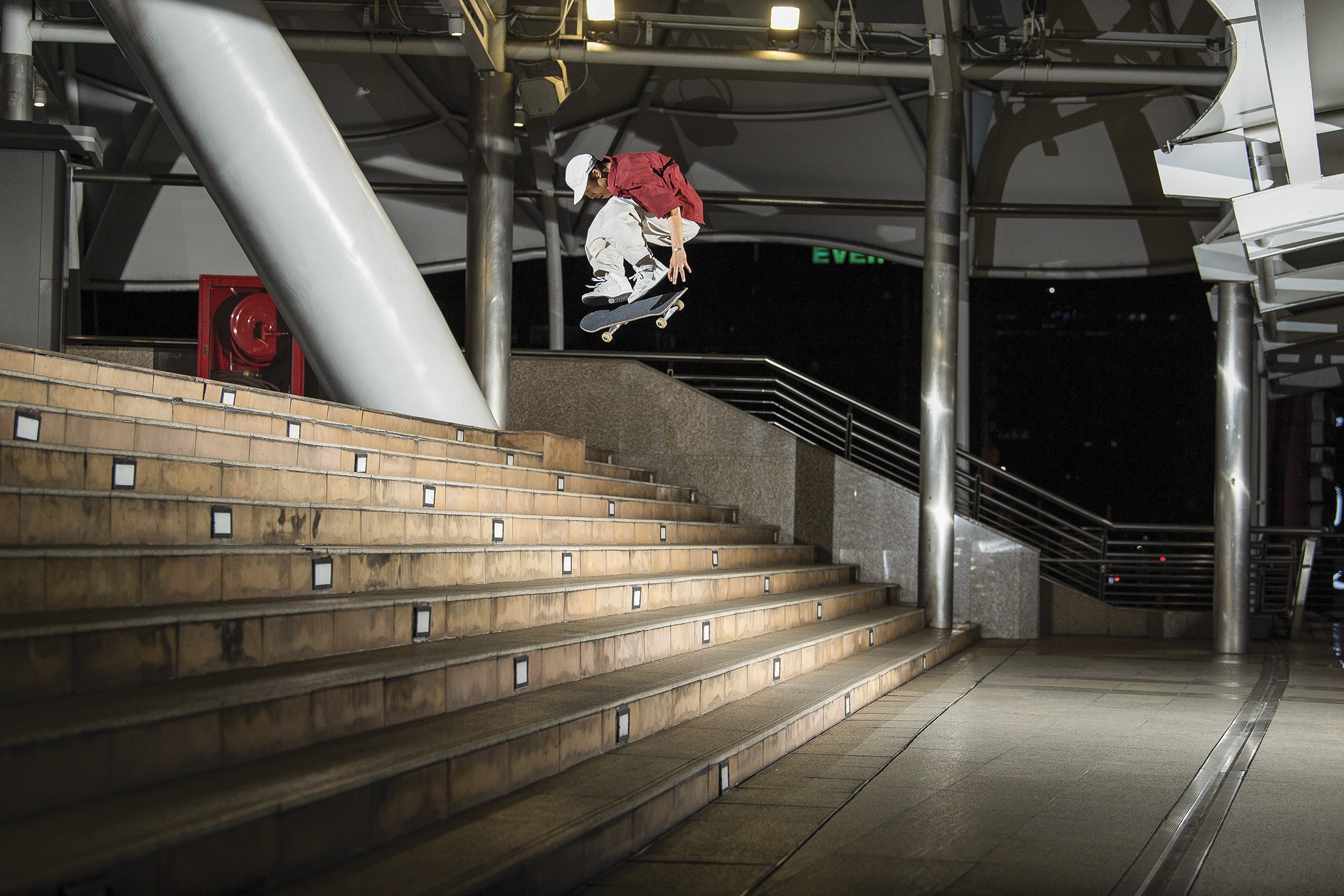
Ryuhei Kitazume – Nollie Backside 180 Kickflip ~ Photo by: Iseki Nobou
Of course, none of these things would gel without the right group of skateboarders for them to coalesce around; and, watching Lenz III, we see a broad swathe of Japan’s best street skaters gleefully exploring the abstract potential of their architectural surroundings. Of all those involved, Ryuhei comes across as one of the more ‘classically trained’ skaters; someone who grew up hanging around at a plaza, and has stated before the influences that US East Coast videos had on his skating. It seemed only fitting to ask him what some of his favourites are, in terms of both look and music choice; because, as much as we are shaped by location, we also live in a hyper-mediated society that sees skateboarding tropes stretched as thin as Hokusai’s Great Wave, made ghostlike by a bombardment of images clamouring for consumption in a great cacophonic roar that would cause Baudrillard to fall down dead, bleeding from the eyes and ears, of an immediate and catastrophic brain embolism if he were alive to see it, millions upon millions of works of art in the age of hypercapitalist re-reproduction. This surfeit of the visual images, the ways it they are handled, distributed and consumed, means that we are just as much shaped by the videos we have watched, sat at home before or after the session, dreaming of spaces beyond those outside our front door, as we are by those outside spaces themselves. So, what is it about those rainswept plazas whose images were being beamed across oceans and whose particulars were being carefully noted by a young Ryuhei?
“I’ve always loved watching footage from Love Park. My interest really grew after I saw the documentary ‘Love Story’. As for more recent East Coast videos, I really liked Cyrus Bennett’s part in Johnny’s Vid, and Tyshawn’s Play Dead part. But there’s something special about how much footage came out of Love Park and Muni, and the music in those videos – classic ’90s hip-hop – was exactly what I’m into. That’s why I became such a big fan of the Sabotage series by Brian Panebianco. Stevie Williams and Josh Kalis were big favourites of mine. That switch heel from Josh Kalis’ DC part really left an impression on me. The way Love looked reminded me a lot of Sega Mae. Both were open plazas with a strong local scene, so it really resonated with me.”
And who was it at Sega Mae who really opened his eyes to the possibilities of skating? I ask Ryuhei to narrow it down to a top three. “Zizow, the no.1 OG no doubt. I really like how he dresses and does tricks. He was already skating Sega Mae when I was born, how crazy is that! Junya Fire, the funniest dude ever to skate with, always good times to hang out with both on and off the board. And Toeda, he’s the guy who showed me the skate world; filming, tours and stuff, you know? He’s 9 years older than me and still rips. Much respect to this guy.”
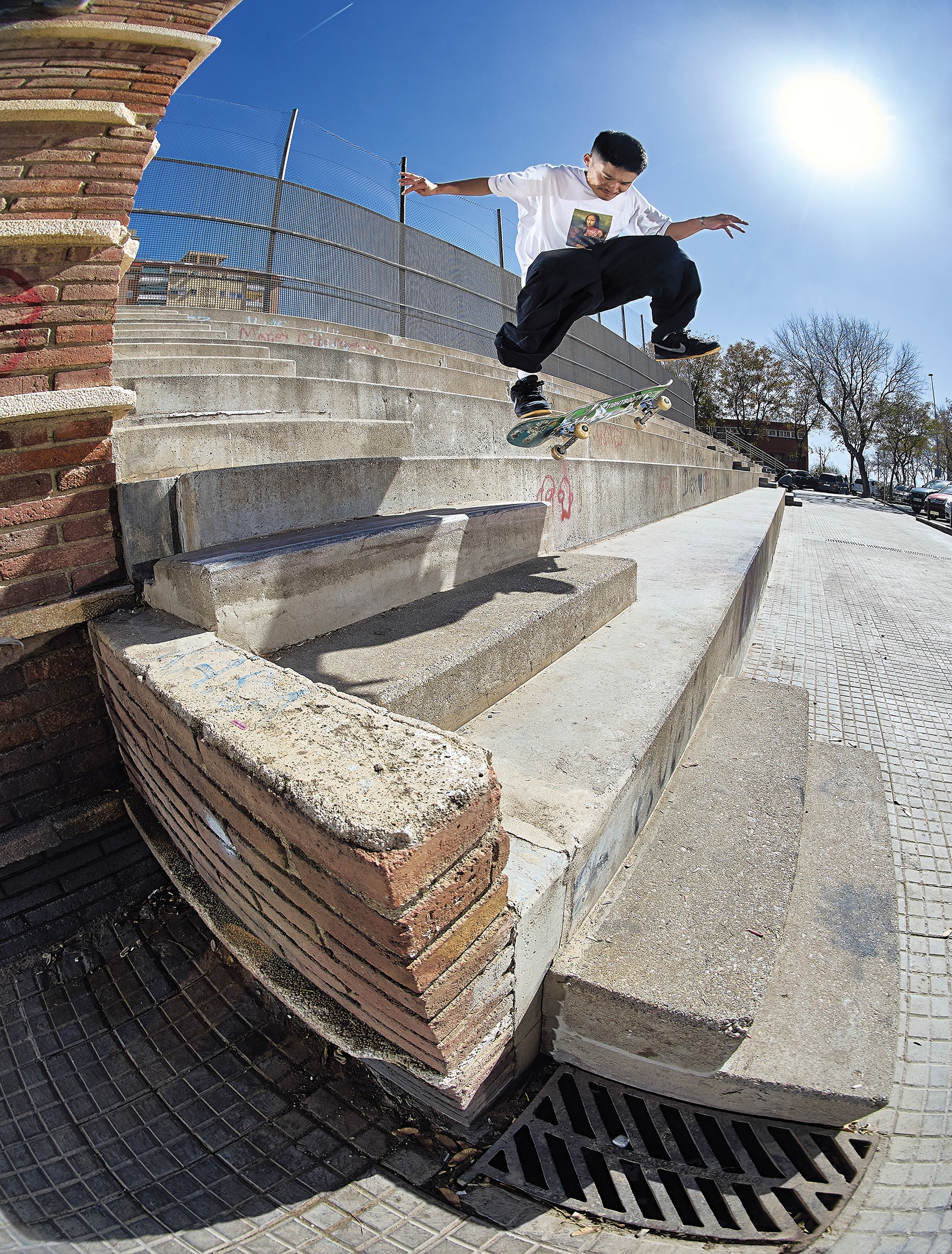
Ryuhei Kitazume – Nollie Heelflip Crooked Grind ~ Photo by: Gerard Riera
Directed + Edited by: Shinpei Ueno
Filmed by: Naoya Morohashi, Shingo Ogur + Kyota Kamei
Motion Graphics by: Kensuke Sugimoto + Tomoyuki Kujirai